


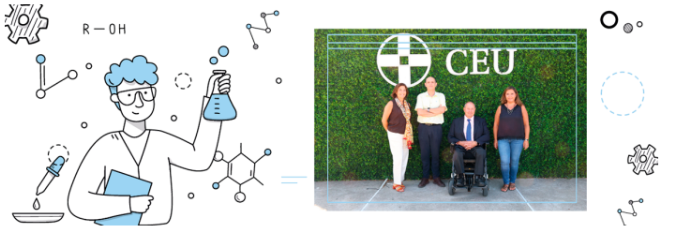
‘New Biotechnological Solutions for a Circular Economy of Olive Pomace’ is the title of a new project awarded to the Research Group of Plant-Microbiome Interaction Biotechnology at CEU USP, led by Professor Francisco Javier Gutiérrez Mañero. Circular economy, environmental biotechnology, sustainability, biodiversity, and soil agronomic health are the main focuses. The project is co-funded by the European Agricultural Fund for Rural Development (EAFRD) (80%) and the Ministry of Agriculture, Fisheries, and Food (20%).
Olive pomace, a residue derived from the olive oil extraction process, of which approximately five million tons are produced annually in Spain, is becoming a serious problem for oil mills. Various uses for this waste are being sought to revalue it within a circular economy. One of these is its use in agriculture as a fertilizer, a central aspect of the project’s objectives.
To be used as fertilizer, the alperujo must meet the requirements established in Royal Decree 1051/2022, of December 27, which sets out standards for sustainable nutrition in agricultural soils. These standards indicate that the alperujo must have a maximum moisture content of 25% and a concentration of polyphenols below 0.8%. This last condition is precisely the most difficult to achieve, and the CEU research group will intervene using a biotechnological approach. By leveraging the extensive collection of microorganisms that the group has developed from years of research in environmental biotechnology, a set of bacterial strains—a consortium—capable of degrading the phenolic compounds present in the alperujo will be selected to reduce them below 0.8%.
This consortium will not only help achieve the indicated polyphenol levels in the regulation, but it will also enhance the microbial biodiversity of agricultural soils when incorporated along with the alperujo into those soils, thus creating healthier and more fertile soils that will lead to more sustainable production. An approach from environmental biotechnology that perfectly aligns with the objectives of the European Commission, which aims to integrate environmental and climate policy across other community policies, as reflected in the European Green Deal. Among the main tools of this pact in the agricultural sector is the From Farm to Fork Strategy, which aims to design a fair, healthy, and environmentally respectful food system.
The project ‘New Biotechnological Solutions for a Circular Economy of Alperujo (REGAGE23e00065119107) falls under the call for Innovation Projects of general interest by Supra-autonomous Operational Groups of the European Union for Innovation in agricultural productivity and sustainability (AEI-Agri), within the framework of the Strategic Plan of the CAP of Spain (PEPAC). It is part of a collaboration between the university and industry and, alongside San Pablo CEU University, involves six other participants: Agricultural Cooperatives, DCOOP, DMC Research, El Ejidillo Viveros Integrales, BIOVEGEN, and the Institute of Fat-CSIC.

“Content responsible: SIMBIOLIVA OPERATIONAL GROUP”