


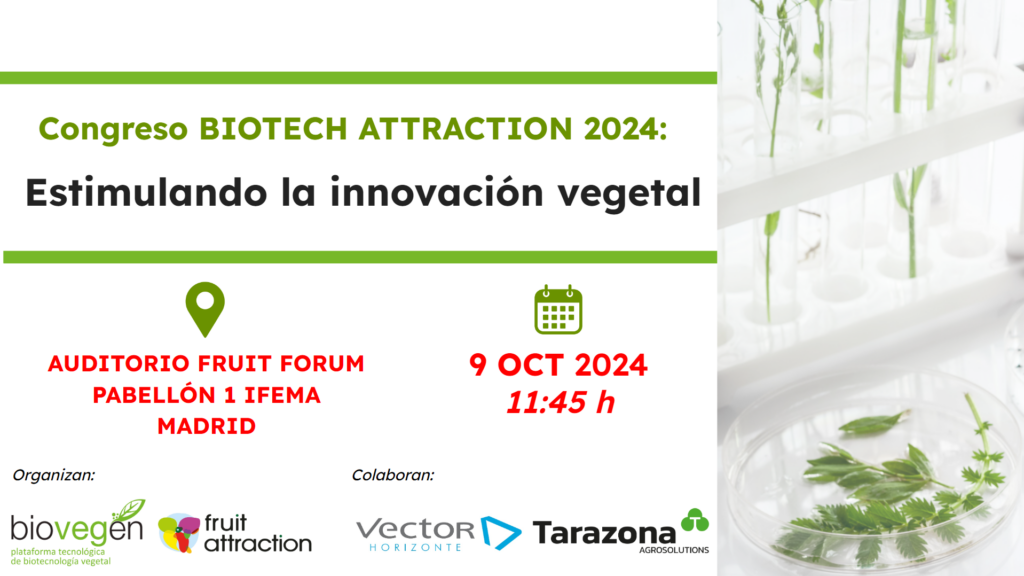
- The BIOTECH ATTRACTION Congress by BIOVEGEN held at FRUIT ATTRACTION highlights that the new techniques are more “rapid, effective, and precise”: not only CRISPR mutagenesis but also base editing, ‘prime’, cisgenesis and intragenesis, and synthetic biology. Their applications in the EU will depend on the wording of the “fine print” of the future regulation
- Europe is currently turning its back on a new generation of crops obtained through CRISPR that have already been approved in the US, China, or Japan – starch-rich corn, mildew-resistant wheat, tomatoes to lower blood pressure… – and on the regulations that support these techniques also in Canada, Australia, England, China, Israel, India, Brazil, or Argentina
More than 350 scientists and entrepreneurs from the agricultural sector filled the Fruit Forum during the First Congress organized by BIOVEGEN, the platform that promotes biotechnology in this sector, held during the recent edition of Fruit Attraction (Madrid). One of the major themes addressed was the scope of the regulatory proposal from the European Commission (EC), approved on February 7 by the Parliament, concerning New Genomic Techniques (NGTs) and the advancements achieved in plant improvement through these methods. Diego Orzáez, a researcher at CSIC in the IBMCP (Institute of Molecular and Cellular Biology of Plants, in Valencia), highlighted how these techniques have evolved in recent years to become “faster, more effective, and more precise.” In this race for genetic editing, the EU—which has yet to conclude the debate on the regulations that will govern them—lags behind other Western powers. As Orzáez described, the market now has “a first generation of commercial fruits” obtained by CRISPR: a maize with high starch content, tomatoes enriched with GABA to lower blood pressure (both approved in Japan); a Romaine lettuce that does not brown, less bitter and milder mustard leaves, low saturated fat and zero trans soy oil, a mushroom that does not oxidize and prevents browning and softness, a potato resistant to certain pests, with reduced sugars and low acrylamide content (in the US); varieties of apples that do not oxidize (Canada), or wheat resistant to the downy mildew fungus (China). Crops already approved and available thanks to favorable legislation that, beyond the mentioned powers, is also found in Australia, England, India, Pakistan, the Philippines, Israel, Brazil, Argentina, or Chile, among others.

The IBMC researcher explained how, starting from targeted mutagenesis using CRISPR-Cas 9 (‘editing’ parts of a molecule without inserting foreign material), there has been progress towards analogous techniques with additional functionalities that can also be combined. Among them, he mentioned the most relevant ones, such as base editing (to modify a single nucleotide of a DNA molecule); prime editing (which allows for rewriting small sections of the genome with great precision over a few nucleotides); cisgenesis (which induces changes using genes from sexually compatible plants) and intragenesis (which combines sequences from the same species or a closely related one) and finally, synthetic biology (which aims to design or redesign biological systems and endow them with new and/or improved qualities).
For her part, Leire Escajedo, a professor at the University of the Basque Country, addressed the new European legislative developments in plant breeding. The lawyer also recalled that the current legislative framework is based on the genetics of the 90s and it was the Court of Justice of the EU (CJEU) that ruled in 2018 that it was necessary to review it to adapt it to NGTs, which are still subject to the current restrictions for genetically modified organisms (GMOs). She also analyzed the text that, as a result of this ruling, was proposed by the Commission and which was supported, with some amendments, by the European Parliament (EP) in February. Escajedo valued it as a “progress” that the proposal – which still needs to be debated at the Council, that is, at the level of member states and then start the so-called trilogue process between the Commission, the EP, and the Council itself before being approved – includes a “differentiated legal status” for NGTs. She clarified that the text currently being debated divides plants obtained through these techniques into two: NGT-1, whose genetic modifications could have been obtained through traditional methods (with successive crosses and selection), although taking a lot of time and after many generations, and therefore they are considered equivalent (these plants would be exempt from the GMO directive); and NGT-2, whose modifications would still be regulated by the aforementioned directive, although with a risk assessment that would take other considerations into account (for example, if the resulting plant were more sustainable, they might not have to face the complete dossier that must currently be prepared in the case of GMOs). The supposedly ‘objective’ difference between one and the other, beyond such a description, would be the number of genetic changes made in the genome: up to 20 would fall into the first group, while more would fall into the second.

But this criterion of 20 modifications, as Orzáez himself also confirmed, is not so clear, so “we will have to be attentive to what the fine print of the final text says,” added the lawyer. “If, in practice, the only thing we are going to regulate is what we could already do (with more time and less precision than the NGT’s, referring to the innovations that will be included in NGT-1), we didn’t need these saddlebags for this trip,” stated the IBMCP scientist decisively. The key will therefore be in how those modifications are quantified because, if a restrictive interpretation is made, “many of the uses and applications of the new techniques we are already working on would not be viable,” decreed Orzáez.
Biostimulants, innovations, and financing
The situation regarding European regulation of biostimulants – substances, mixtures, and microorganisms that do not serve as nutrient inputs but instead activate the natural processes of plants to improve their yields – is quite different. It was Estefanía Hinarejos, director of Regulatory Affairs at Alga-Energy – a Spanish multinational specialized in these products – who analyzed the perspectives generated following the entry into force, in July 2022, of Regulation EU 2019/1009. Hinarejos positively evaluated the approval of this regulation, which mandates manufacturers to demonstrate their function through efficacy trials. However, the expert lamented that despite the existence of many proven effective microbial biostimulants that have been commercially available under national laws for years, the regulation recognizes only 4 types of microorganisms. This led to her conclusion that the regulation still suffers from “shortcomings that are currently being supplemented by partial harmonization” (that is, by relying on the legislation of the member states). Furthermore, she called for a development guided by “proportionality” that is “realistic” in the requirements for the certification of new products.
The I Congress of BIOVEGEN also announced two innovative public-private projects: Patafest, a consortium of companies and European research centers offering biosolutions to combat serious potato crop diseases, such as the so-called ‘C Zebra chip’ (caused by the bacteria Candidatus Liberibacter solanacearum), as well as other common post-harvest problems in this tuber (Fusarium sambucinum, Colletotrichum coccodes, Helminthosporium solani); and the company Agrícola 2000 and its ‘Campo Demo’ program, dedicated to providing companies with plots to physically showcase the advantages of their products, or to consumers, to evaluate firsthand the desired characteristics of the varieties or products being tested.

As is customary in other previous sessions, BIOVEGEN also wanted to leave space to present the tools available for financing this type of project. This is when Antonio Santa Cruz, from the company Vector Horizonte -specialized in offering this service- reviewed the existing alternatives regarding national and European subsidies, tax deductions, bonuses for research staff, or the so-called ‘patent box’ (a tax incentive that allows a reduction in the tax rate on the transfer or transmission between entities of intangible assets derived from R&D activities). In this same line, Alejandro Marín from the Inventium fund, part of the ABANCA Group, specialized in connecting private investors with disruptive initiatives of this type, spoke. The Congress was closed by the director general of the CDTI, José Moisés Martín.
Video summary
Gallery


Program and presentations
11:45 h. Registration and collection of accreditations
12:00 h. Welcome and introduction
- María José Sánchez. Director FRUIT ATTRACTION
- José Pellicer. President of BIOVEGEN
12:15 h. Unleashing the potential of CRISPR CAS in plants
- Diego Orzáez. IBMCP-Institute of Molecular and Cellular Biology of Plants
12:45 h. Legislation in agri-biotechnology: advances and opportunities in plant breeding and biostimulants
- News in plant breeding. Leire Escajedo. BASQUE COUNTRY UNIVERSITY
- Legislation on biostimulants: situation and perspectives. Estefanía Hinajeros. ALGAENERGY
13:15 h. Innovative public-private projects
- PATAFEST: biosolutions in potato cultivation and post-harvest. Christian Ghidelli. FUNDITEC
- DEMO FIELD: trials of varieties and bioinputs. Giacomo Scatolino. AGRICOLA 2000
13:45 h. Tools to stimulate R&D&i
- Overview of R&D financing tools. Antonio Santa Cruz. VECTOR HORIZONTE
- Private investment in agbiotechnology. Alejandro Marín. INVENTIUM
14:15 h. Conclusions and closing. José Moisés Martín. General Director. CDTI
14:30 h. Cocktail and networking