


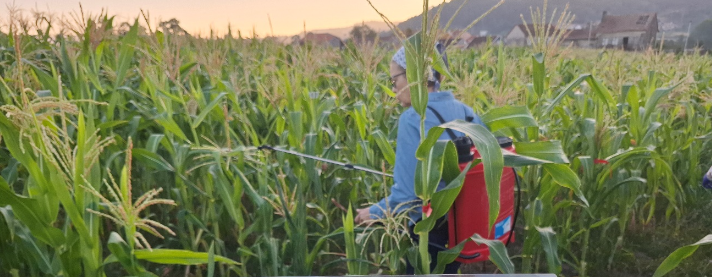
One of the objectives of GO BIODIF is to study the effect of fortification with Ca and Ca+Zn nanoparticles on the nutritional composition of corn grain. To this end, an experiment has been designed to evaluate whether the application of nanoparticles has these properties. The study, which is part of a sustainable biofortification strategy, is being carried out at the Biological Mission of Galicia (MBG-CSIC).
To achieve this, a factorial experiment has been designed using two corn varieties (Oubiña negro and Tuy) on which three repetitions have been performed. Oubiña negro has semi-smooth black grain, with good production and is slightly late. Meanwhile, the Tuy variety has smooth yellow grain and presents good medium-cycle production. Each repetition consisted of three treatments (control, Ca nanoparticles, and Ca+Zn nanoparticles) applied at three different times: i) at flowering, ii) at flowering and 10 days after application, and iii) at flowering, 10 days, and 20 days after flowering.
The experiment began on May 8 with the sowing in the Espaller plot of the Biological Mission of Galicia. The treatments were applied in July and August, coinciding with the flowering date of each variety. One week after each treatment, an optical sensor (Dualex) was used to measure the leaf content of flavonoids, anthocyanins, chlorophyll, and nitrogen balance index. Additionally, agronomic characteristics such as the flowering percentage, plant height, subjective aspect of the plot, grain moisture, and yield at harvest were measured.

Subsequently, on October 3, the collection took place, and grain samples were taken for nutritional analysis using NIR and for its use in baking by Da Cunha. Samples of crop residue were also taken to analyze the fortification of these residues with NIR.