

Genomic editing is a revolutionary technology whose significance has been recognized with the awarding of the Nobel Prize to its discoverers. Its application to crop improvement transcends the realm of research.
Genomic editing is a new approach to genetic enhancement based on knowledge, which leverages the plants’ own natural solutions, helping to reduce current requirements for external inputs and making food production more environmentally friendly.
The decision of the EU Court of Justice to subject plants improved through genomic editing to the complicated and costly European regulations on Genetically Modified Organisms (GMOs) places this technology outside the usual realm of obtaining and registering plant varieties.
This represents a significant setback to the expectations and promises that genetic editing offers for the sustainability and competitiveness of a sector like agri-food, which is so important in our country.
The numerous reactions to this ruling have led the EU to conduct a study on its importance and impact within the Union.
BIOVEGEN joins the many academic and business voices that are calling for a revision of this legislation, so that it does not restrict the enormous opportunities that these techniques can bring to Spanish and European agriculture, emphasizing the need to create favorable conditions, based on scientific evidence, for the optimal development of plant production.
In this regard, BIOVEGEN joins and supports the letter launched by EUSAGE (European Sustainable Agriculture through Genome Editing), where the scientific community represented by EU-SAGE highlights the need for EU studies to promote a regulatory status that is fair and non-discriminatory for crops improved through genetic editing in European legislation, and that allows for the development and market introduction of edited genome crops in Europe.
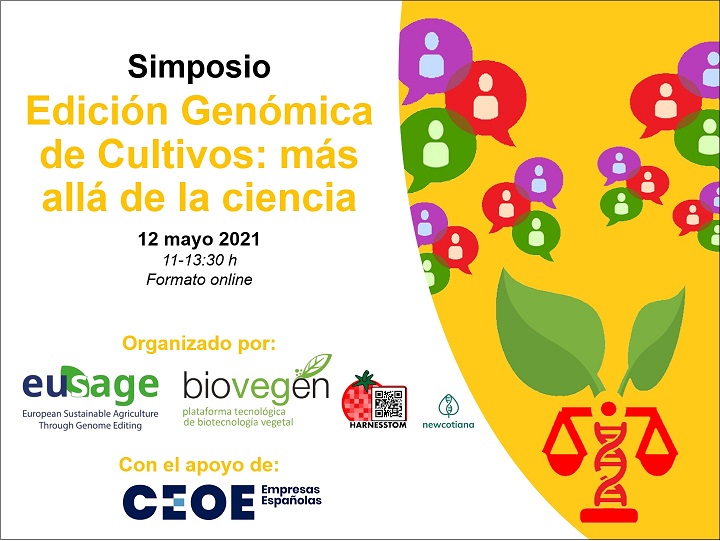
Symposium on Genomic Editing of Crops: Beyond Science. May 12, 2021