


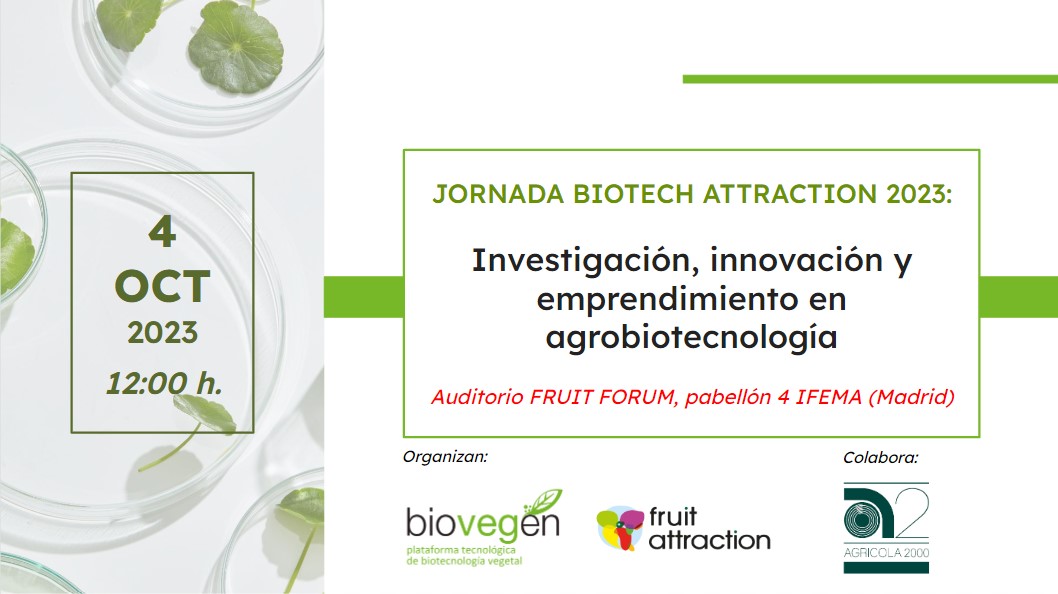
BIOVEGEN sets a record of public attendance at its BIOTECH ATTRACTION 2023 event on bioinformatics, biofertilizers, and alternative proteins
- The biotechnology platform brought together 280 professionals from companies and leading research centers in the country at Fruit Attraction and filled the Fruit Forum, the largest exhibition hall of the fair.
- The CSIC demonstrates how genome data computation, AI, and genetic editing are accelerating plant improvement, in vitro cultivation, phytopathology (for combating pests and diseases), microbiology (viruses, bacteria, fungi, or parasites), and agricultural physiology (the functioning of plants).
- The CBGP works on more sustainable cereals with low nitrogen requirements; the CNB-CSIC is making advances in the cultivation of the plant Lemna as a source of plant protein, as an agent against water eutrophication processes and to capture arsenic from the soil; Agrenvec produces animal protein analogs from plants and Madeinplant generates plant biomolecules for industrial, health, or food use.
Madrid, 10-10-2023.- BIOVEGEN, the platform dedicated to connecting advances in biotechnology research with the needs of companies, has set a record for attendance at its Biotech Day this year. With the new green revolution on the horizon, this year’s event focused on analyzing advances in bioinformatics, the development of biofertilizers, and alternative plant-based proteins to animal ones, filling the Fruit Forum of the Fruit Attraction event –the largest conference venue– and gathering more than 280 professionals from agri-food companies and researchers from the main centers in the country.

Group photo of the speakers of the BIOTECH ATTRACTION 2023
The meeting was inaugurated by the director of this major horticultural fair, María José Sánchez, who recognized the work carried out by this platform both in organizing its Biotech Attraction space – which has celebrated its third edition – and in hosting company talks during the three days of the event (between October 3 and 5, at Ifema), as well as the own session that was starting at that moment.
It was José Pellicer, president of Biovegen, who welcomed the attendees, thanking them for the spectacular response to the invitation and the support offered for organizing everything. The closing remarks were made by the director of the National Institute of Agricultural and Food Research and Technology-High Council for Scientific Research (INIA-CSIC, the largest public consortium of R&D centers in the country), Esther Esteban, who emphasized the importance of communication actions like this one: “We have benefited from the rapid development of vaccines against Covid-19, which would not have been possible without decades of prior advancements in messenger RNA techniques. But in agri-food, it seems that there is a demand to double the verification efforts, hence the opportunity for events like this one, which generate such trust and connection.”

General view of the room during the welcome led by José Pellicer, President of BIOVEGEN.
From the Aula DEI Experimental Station of the CSIC, Bruno Contreras analyzed how new genetic data computing systems, genomic editing techniques, and Artificial Intelligence (AI) are contributing to accelerate the processes of plant improvement, in vitro cultivation (under aseptic conditions, without germs, controlling growth factors), plant pathology techniques (to identify and combat diseases and pests), and microbiology (functioning of plants). Specifically, Contreras detailed the three main tools that bioinformatics offers: 1.- When exploiting the pangenome (that is, the complete collection of genetic data of organisms belonging to the same clade) to use it as a reference for the analysis of a plant’s genome and its improvement with CRISPR-Cas 9 (genetic editing); 2.- For the genomic selection and the combination of haplotypes (which are the groupings of genetic variants that tend to be inherited together) that allow for a better understanding of the biology of the plant and 3.- The AI that enables an immediate and error-free analysis of the organism’s own genomics, images, and phenotype (which are observable characteristics such as morphology, development, properties…).
Immediately afterwards, Miguel Morard, director of the Bioinformatics Unit at ValGenetics, demonstrated how the use of all these tools allows this company to offer services to characterize their clients’ varieties (unequivocally distinguishing them from others, facilitating quality control, for improvement processes using molecular markers…); to taxonomically identify microorganisms and identify biocontrol systems against pests or diseases; for bio-fertilization or bio-stimulation, and for advanced diagnostics in plant pathology.
From the Plant Biotechnology and Genomics Center (CBGP, U. Politécnica de Madrid), Ana Pérez González updated the status of research for obtaining more sustainable cereals, with lower nitrogen requirements. The researcher recalled how -starting from the Haber-Bosch process (1909), based on the reaction of gaseous nitrogen and hydrogen to produce ammonia- the green revolution was consolidated, which made it possible to quadruple the human population while increasing arable land by only 30%. However, this synthesis process has globally required consuming up to 5% of natural gas production, accounted for between 6% and 12% of greenhouse gas emissions, is the source of nitrate contamination of waters, and is also responsible for the eutrophication (contamination by nitrogen and phosphorus reducing the concentration of oxygen in water) of many terrestrial and marine ecosystems. Hence, the CBGP works on the ‘challenge‘ of ‘transferring to cereals the genes that fix nitrogen‘ or exploring ‘the way to activate nitrogenases in plants‘ (the enzymes that allow the natural reduction of molecular nitrogen).
Complementarily, Antonio Leyva from the National Center for Biotechnology (CNB-CSIC) reported on the potential of a simple plant, Lemna – known as ‘water lentil’ and abundant in certain parts of Spain – as a source of vegetable protein, as a way to slow down the aforementioned eutrophication processes in general and to capture arsenic from the soil in particular, for example, in rice plantations. The flooding used to cultivate this cereal prevents the growth of weeds that may attract pests, but the food is highly exposed to arsenite, a chemical form of arsenic that is highly toxic. ‘In some areas of Asia, where it is a staple food, arsenic contamination is a top health issue’, Leyva emphasized.

Fruit Forum Auditorium 4 during the presentation by Bruno Contreras, AULA DEI CSIC
And beyond research, as examples of successful technology transfer, Isabel Bronchalo, CEO of Agrenvec, presented the model of an emerging industry – one dedicated to producing animal-analog protein from plants, animal-free – which will, in the long term, help reduce the number of intensive livestock farms, the most polluting ones. For his part, Federico Grau, CEO of Madeinplant, raised how, using a patented proprietary technology, they are able to redirect production processes towards greener methods by producing biomolecules of interest for sectors like health, agri-food, industry, or research.
In this field, Eva Bataller presented the model created at the University of Valencia – which is, according to the prestigious Shanghai ranking, the leading center in Spain in agri-food – to successfully promote entrepreneurship linked to agrotech and foodtech startups that arise from its Scientific Park. “We solve real problems for R&D intensive companies that are born here and interlink them with what we call leading companies,” she explained, detailing the services they provide, including business and scientific mentoring, access to shared facilities, training, and contact with potential clients. Madeinplant itself is one of the success stories that emerged from this business incubator, which is now working with another 14 companies in the acceleration phase.
Gallery


Program and presentations
- 11:45 h. Registration and accreditation collection
- 12:00 h. Welcome and introduction
- María José Sánchez, director of FRUIT ATTRACTION.
- José Pellicer, president of BIOVEGEN.
- 12:15 h. Potential of bioinformatics in agriculture
- Present and future of bioinformatics in agri. Bruno Contreras, AULA DEI CSIC
- VALGENETICS experience in bioinformatics. Miguel Morard, director of bioinformatics unit VALGENETICS
- 12:45 h. Fixation of atmospheric nitrogen and development of biofertilizers. Ana Pérez González, CBGP (UPM-INIA).
- 13:15 h. Alternative plant-based proteins:
- Potential of lemna as a source of plant protein. Antonio Leyva, CNB-CSIC
- AGRENVEC: molecular agriculture. Isabel Bronchalo, CEO
- 13:45 h. Innovation and entrepreneurship in the agri-food sector
- AGROTEC UV Incubator. Eva Bataller, business development manager
- MADEINPLANT. Federico Grau, CEO
- 14:15 h. Conclusions and closing. Esther Esteban, general director INIA-CSIC.
- 14:30 h. Cocktail and networking