


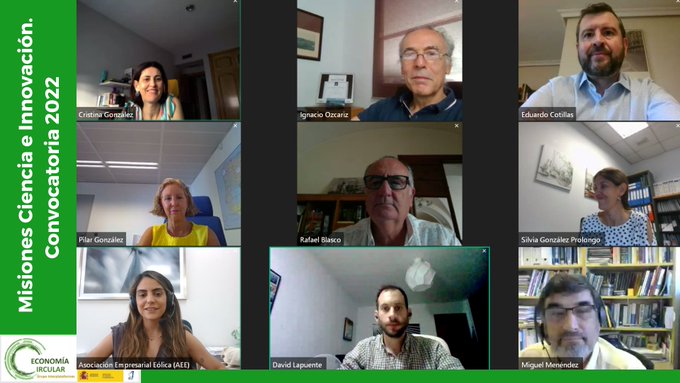
The GIEC, composed of 28 Spanish Technological and Innovation platforms, organized this online event, which had more than 150 attendees.
On July 15, the Group of Interplatforms for Circular Economy (GIEC) organized a webinar to inform interested parties about the details of the Missions Program 2022, in collaboration with the Center for Technological Development and Innovation (CDTI) of the Ministry of Science and Innovation. The session was opened by Cristina González (GIEC Promoting Group, SusChem-Spain) and the presentation of the Call was carried out by María Pilar González, Head of the Department of Institutional Promotion and Territorial Cooperation of the CDTI.
Ms. González commented that the Missions are competitive projects led by companies aiming for significant research that proposes solutions to transversal and strategic challenges facing Spanish society, improves the knowledge and technology base on which Spanish companies rely to compete, while also promoting public-private cooperation.
The meeting was divided into two parts; the first provided information about the circular economy within the Program, and the second, moderated by Eduardo Cotillas (GIEC Promoting Group, Food4Life Spain), presented various project ideas seeking partners with the objective of applying for the call by detailing the general project idea, its current situation, and consortium formation, as well as the types of partners they need.
In the first part, important dates were reported, such as the deadline for submitting project applications and accompanying documentation (September 5, 2022, at 12:00), the start dates of the projects (starting on November 1, 2022, and end date on December 31, 2024, or June 31, 2025), as well as the need to prepare 2 reports, one concerning the project and the second regarding compliance with the Do No Significant Harm Principle (DNSH).
Finally, questions from the attendees were addressed, where it was reminded to the interested parties that the minimum budget per company is 175,000 euros, that the same company can be in several consortia, that dissemination expenses are not included, or that a foundation without a profit motive would not enter the Program.
In the second part, presentations of five project ideas were made, where presentations under the title “Recycling CO2 to fuel from the University of Zaragoza,” “Elimination of inhibitors in the production of second-generation bioethanol through biological means from the University of Extremadura,” “Application of Neuro-Quantum computing to electricity storage by RQuan Tech Sari,” and “Development of Recyclable and Sustainable Composite Materials from the Rey Juan Carlos University” were exhibited.
These project ideas and many others can be consulted in the online tool “Connecting Ideas.”