


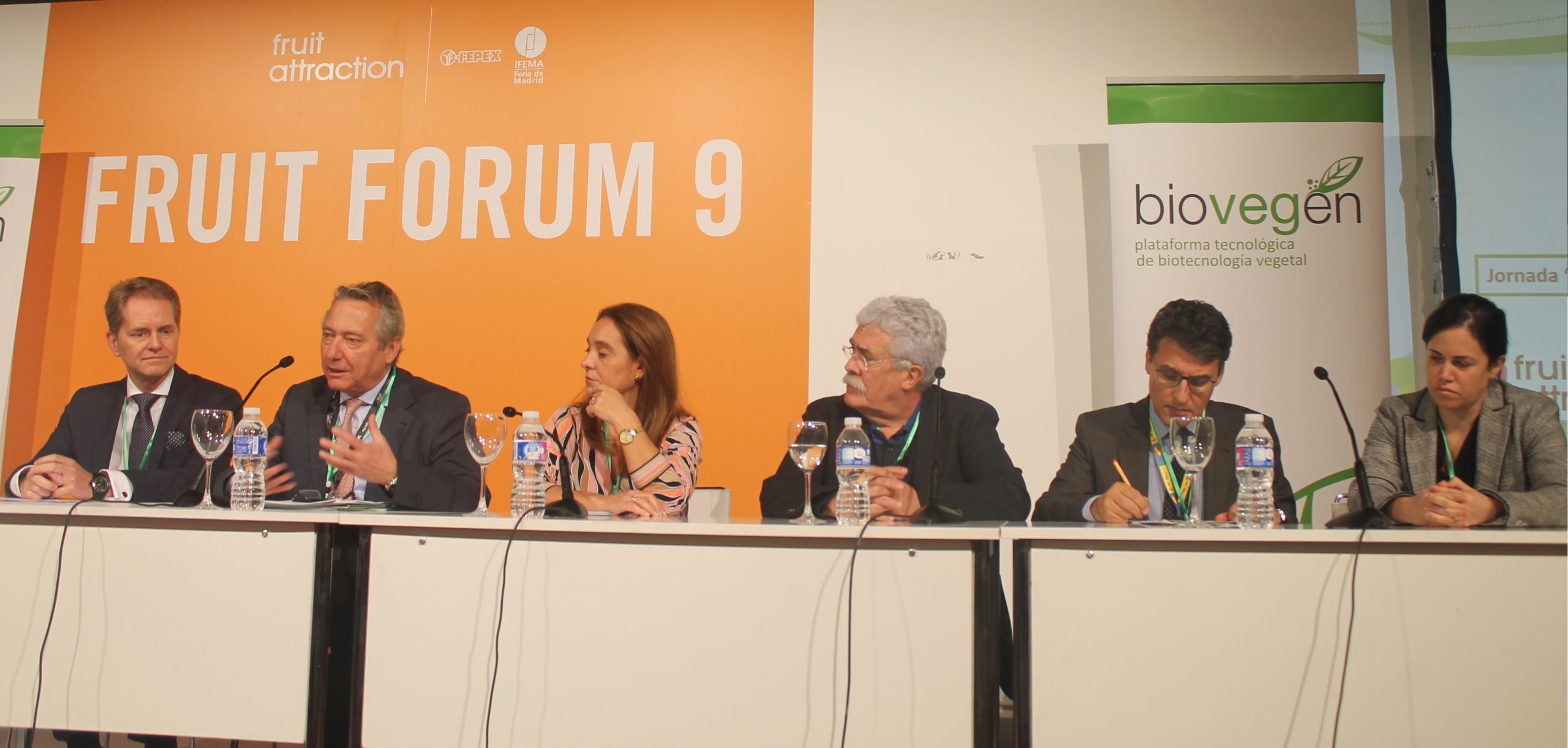
On October 19, 2017, the BIOVEGEN Day “TECHNOLOGY ATTRACTION: Science, Business, and Technological Revolution” was held. The event, part of the International Fair FRUIT ATTRACTION (IFEMA, Madrid), brought together about 200 agents from the agri-food sector engaged in R&D, coming from research, business, and administrative backgrounds.
- 87 companies (improvement, production, marketing, agri-biotechnology, nutrition, health and plant protection, R&D management, etc.)
- 37 Research Organizations (Universities, OPIs)
- 13 Others (Administration -CDTI, MINECO, MAPAMA, OEPM, OEVV…, embassies, regional ministries…)
The goal of the Day was to bring together prominent representatives from Science, Business, and the Spanish Administration to convey the technological revolution occurring in Plant Biology, highlighting the crucial competitive improvement tool that these advances provide to the plant production sector, as well as the international context and trends in this regard. During the event, recognized experts (see curriculum references) in the field of Plant Biology and the agri-food sector presented the current landscape, approached from the perspective of Science, Business, and Administration.
The opening of the Day, led by the current director of INIA, Manuel Lainéz, also featured the presence of José Pellicer, President of BIOVEGEN, and Antonio Leyva, Executive Secretary of BIOVEGEN. The three welcomed the attendees and presented the Day, which, held in the context of the Fruit Attraction Fair, aimed to foster greater alignment between the Technological Supply and Demand, to make the investment in research profitable, and to develop opportunities for collaboration and business.

Next, Gonzaga Ruiz de Gauna, director of BIOVEGEN, publicly outlined the draft document ‘Analysis of the Agri-Food Sector and proposals for improvement in R&D&i’ prepared by this entity. This document, which will be developed over the coming months and is open to contributions from the entire sector, aims to serve as a tool to help improve the situation of knowledge and technology transfer and the private sector’s utilization of the business development opportunities that R&D offers.
José Pio Beltrán, former president of EPSO (European Plant Science Organization) and Spanish scientist currently researching at the Institute of Molecular and Cellular Biology of Plants (IBMCP-CSIC) made the first presentation coinciding in his fundamental diagnosis: Spain is a great agricultural power, has significant and quality scientific production, an impressive network of leading public organizations (20 agricultural centers affiliated with CSIC, 17 regional ones coordinated by INIA, 37 universities active in biotechnology, and another 32 technology parks) but an atomized agri-food business structure, distant from the world of science and that does not adequately value innovation as a factor of competitiveness.

Secondly, Marta Tortajada approached her presentation from the perspective of the private sector, specifically that of a Valencian company developing biotechnology products, such as probiotics, with applications in functional food.
Next, the head of innovation affairs at CEOE, César Maurín, offered the vision of his institution and advocated for a paradigm shift in incentives for agricultural R&D: “One of the problems with these programs is that a significant part of the budgets is not executed. The plans based on partially refundable credits have not been interesting in many cases and it would be advisable to give more weight to subsidies and less to loans.”
María Ángeles Ferre (responsible for the scientific-technical thematic programs of the State Research Agency, Ministry of Economy, Industry and Competitiveness) highlighted the evolution of the funding programs for public-private projects managed by her department, such as the Retos-Colaboración call, and pointed out that, in this program, “the percentage of agri-food companies benefiting from our credits is higher than that of other strategic sectors, such as energy and transport.” Additionally, she outlined the details of the upcoming Retos-Colaboración 2017 call, with a budget of 400 million € (100 M € in grants and 300 M € in credit).

The event also featured a round table where all speakers and attendees could engage in a discussion about the R&D situation in the Spanish agri-food sector. Some of the topics discussed included the following:
- The Spanish sector is good at researching with money but average at making money from research (“we investigate but do not innovate”)
- It is essential to break the disconnect between Science and Business to be competitive in innovation, not just in production costs
- To achieve this, it is necessary to articulate tools that facilitate this approach: financing mechanisms, innovation agents, etc.
- One of the main problems is that the budgets dedicated to R&D are not executed at a high percentage
- There is a need to enhance direct contact between researchers and companies so that companies can convey their technological needs and researchers can advise them on the opportunities presented by new technologies (researchers as “technological advisors”)
- Meeting forums between research and business are needed
- It is necessary to move towards a new paradigm where subsidies are prioritized to share risks with the private sector and achieve greater execution of the budgets
- Technology Platforms are a valid and effective project promotion agent, supported and coordinated for a long time by the MEIC and showing its positive impact
- Furthermore, a horizon is opening towards greater public-private collaboration from the administrations, both national and European, where there will be more programs and investment for Science-Business projects
Finally, the General Director of Agricultural Productions and Markets at the Ministry of Agriculture, Fisheries, Food and Environment, Fernando Miranda, closed the session by emphasizing the need for initiatives like BIOVEGEN to link science with business, providing more opportunities for innovation. Additionally, he mentioned that Spain will advocate for regulation “based on science, free from the constraints of GMOs” for genomic editing (New Plant Breeding Techniques) and stated: “we are good at innovating with euros but regular at making euros with innovation.”

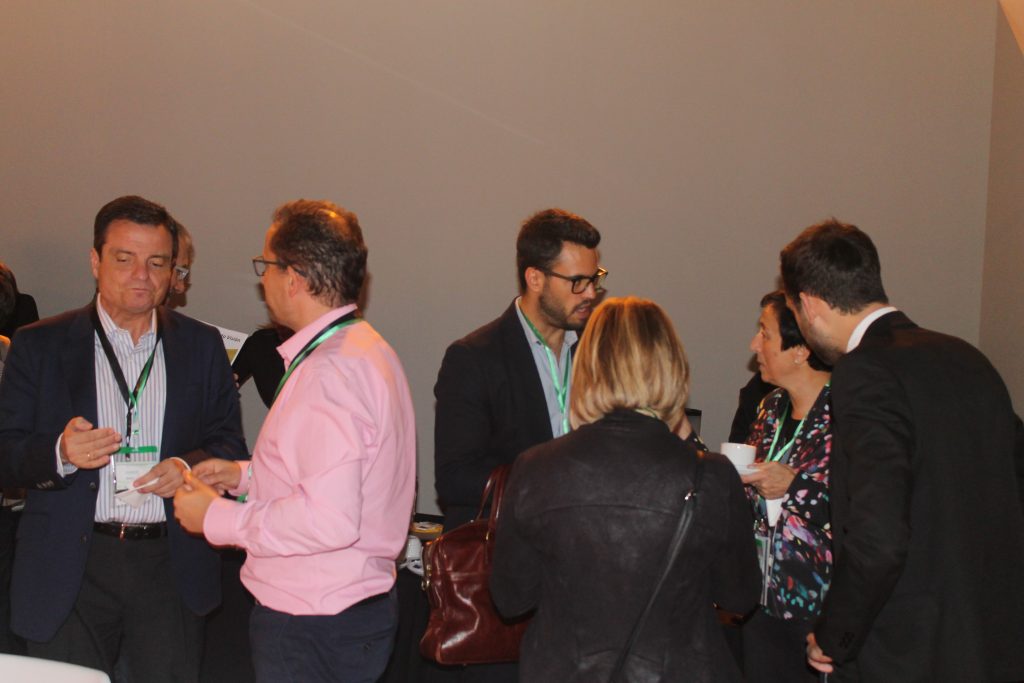
The session clearly showcased the business development opportunities that new techniques in plant biology present and highlighted the growing importance of technological development for enhancing the competitiveness of the Spanish agri-food sector. Finally, a cocktail was offered to the attendees, which served to foster interactions between the public and private sectors through representatives from the numerous entities that attended the event.
Gallery


Program and presentations of the session
12:00 h. Welcome and introduction
- José Pellicer. Director R&D+i Grupo EUROSEMILLAS. President BIOVEGEN
- Antonio Leyva. Scientific Researcher. CNB-CSIC. Executive Secretary BIOVEGEN
- Manuel Lainez. Director INIA
12:15 h. Progress Document Vision BIOVEGEN
- Gonzaga Ruiz de Gauna. Coordinator BIOVEGEN
12:25 h. Perspective of SCIENCE
- José Pio Beltrán. IBMCP-CSIC. Research Professor. Former President of EPSO
12:45 h. Perspective of BUSINESS
- Marta Tortajada. BIÓPOLIS
- César Maurín. Head of the Industrial Affairs and Innovation Area. CEOE
13:25 h. Administration Perspective
- María Ángeles Ferre. Thematic Scientific-Technical Programs. Ministry of Economy, Industry, and Competitiveness
13:45 h. ROUND TABLE: colloquium and questions
- All speakers
- Moderator: Antonio Leyva. Scientific Researcher. CNB-CSIC. Executive Secretary BIOVEGEN
14:15 h. Closing
- Fernando Miranda. Director of Agricultural Productions and Markets. Ministry of Agriculture, Fisheries, Food, and Environment
Cocktail and networking