


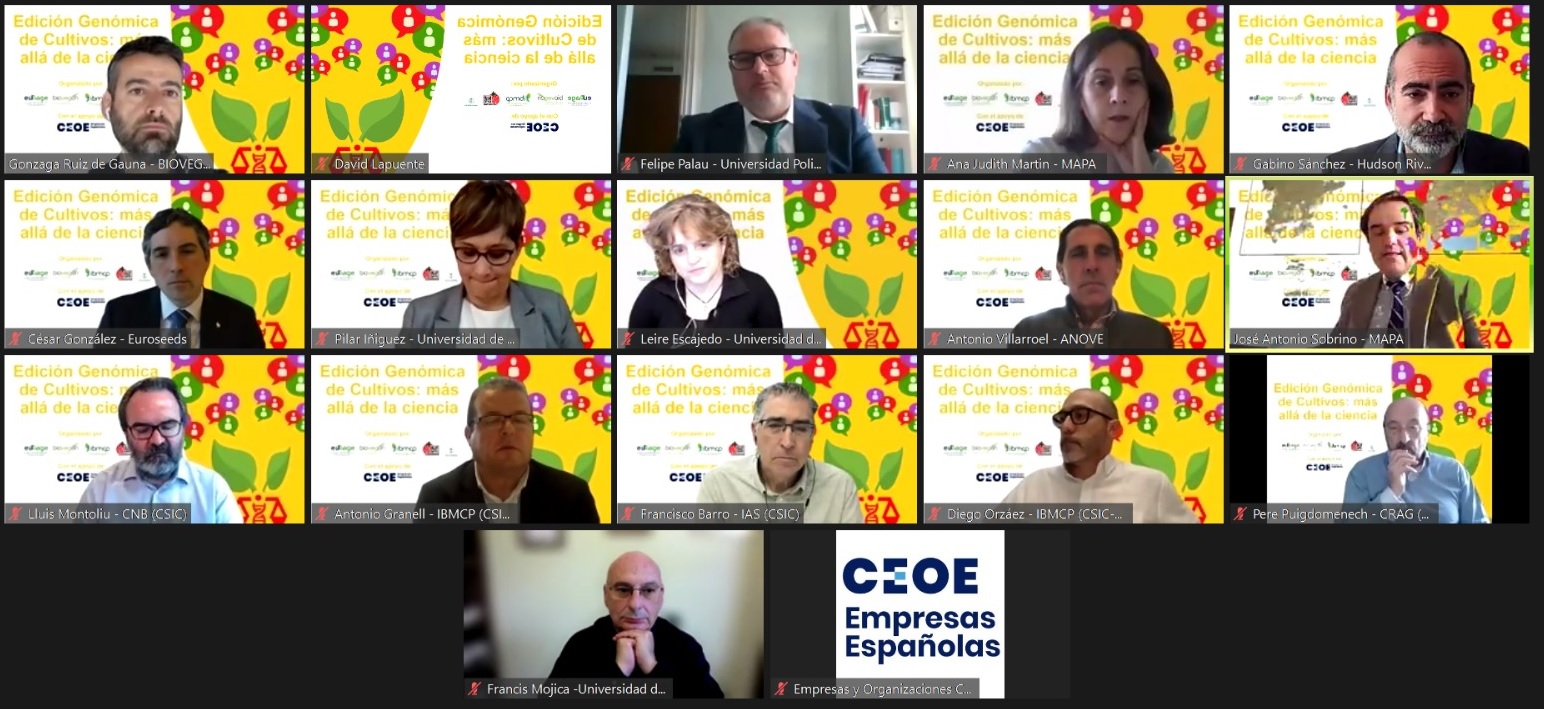
The symposium “Genomic Edition of Crops: Beyond Science” brought together more than 400 participants virtually on May 12, including prominent scientists, legal experts, and representatives from the Spanish agri-food sector, to review the state of genomic editing and its application to agriculture. Organized by the Spanish section of EU SAGE (an alliance of over 130 scientific societies and research centers in Europe) and BIOVEGEN-Technological Platform of Plant Biotechnology (an association of 135 companies and research centers in plant innovation), the symposium was sponsored by the Spanish Confederation of Business Organizations (CEOE), and featured the opening by the Minister of Science and Innovation, Pedro Duque, and the closing by José Antonio Sobrino, Deputy Director General of the Ministry of Agriculture, Food and Environment.
“Spain has leading research groups in genetic crop editing that are making significant contributions, but unfortunately many of these developments cannot reach the market in Europe due to the barriers posed by current restrictive legislation. It is necessary for Europe to eliminate these barriers as soon as possible”. This was stated by Antonio Granell, a researcher at the Molecular and Cellular Biology Institute of Plants (UPV-CSIC) and organizer of the symposium during its presentation.
Throughout the day, the state of the art of genomic editing and its application to agriculture was reviewed. The social, economic, and sustainability consequences derived from implementing a more restrictive or permissive regulation were also discussed. Additionally, the ethical, legal, and competitiveness aspects were analyzed with the help of experts from different disciplines, including representatives from the fields of research, business, economics, and bioethics.
Gonzaga Ruiz de Gauna, director of BIOVEGEN, highlighted that the productive sector needs to innovate to have varieties with which to compete under equal conditions. “Moreover, genomic editing is a fundamental technology to achieve the productivity and sustainability objectives set in the European strategy ‘From Farm to Fork’. It would be very difficult to understand that a technology so beneficial for the entire value chain, from producer to consumer, is accessible in other advanced countries like the US, Canada, or Japan, where it is not subject to strict regulation, and not so in Europe, forcing value chain stakeholders to move to third countries to apply it.”
Consultation of the European Commission
This symposium took place two weeks after the European Commission published the results of a study on the impact of genomic plant editing. Following this study, the Commission will initiate consultations with member countries, gathering their opinions on whether the current legislation, which dates back more than 20 years, is adequate in view of the challenges posed by genetic editing and the important role that new breeding technologies can play in the innovation of the agri-food sector.
“The regulations must protect innovations while considering the interests of citizens and the environment, but they must adapt to new technologies. There are mechanisms to adapt current legislation, exempting genetic editing from the over-regulation of GMOs, just as it does with plants improved through physical or chemical mutagenesis. Alternatively, creating ad hoc legislation for edited plants is a matter of political will.”, stated Felipe Palau, Professor of Commercial Law at UPV and moderator of the session on social, economic, and legislative aspects of the symposium.
According to a recent report published by CAJAMAR, the agri-food sector in Spain, including distribution, contributed 102.983 billion euros to the Spanish economy in 2019, which represents 9.1% of the gross added value, and has generated 2,397,279 jobs, 11.8% of the national total. Despite these figures being higher than the European average, our country invests less in R&D&i in agri-food than the EU-28 average.
“A specific investment aimed at facilitating the development and incorporation of new improvement technologies into the Spanish productive fabric through public-private consortia would allow us to achieve a leadership role in this strategic sector for our country.”, assured Toni Granell.
The Symposium highlighted the potential and high degree of development of these techniques to address the productive and environmental challenges facing the EU, as well as the excellent scientific and business resources that Spain has to participate in this development.
It was also recalculated the urgent need for the European productive sector to access these technologies and their derived products on equal terms with other farmers worldwide. In this regard, decision-making mechanisms similar to those already implemented in other developed countries were proposed, to promptly implement legislations aligned with scientific and technological evidence.
Recordings and presentations from the Symposium
11:00 a.m. Welcome and opening.
- Toni Granell. IBMCP (CSIC-UPV)
- Pedro Mier. President of the R&D Commission. CEOE
- Pedro Duque. Minister of Science and Innovation. Ministry of Science and Innovation
11:30 a.m. Genomic editing, a revolutionary technology in agriculture and plant biotechnology.
Moderator: Antonio Granell. IBMCP (CSIC-UPV)
- Francis Mojica. University of Alicante
- Lluis Montoliu. CNB-CSIC
- Francisco Barro. IAS-CSIC
- Diego Orzáez. IBMCP (CSIC-UPV)
- Pere Puigdomènech. CRAG (CSIC-IRTA-UAB-UB)
12:10 h. Round table
12:40 h. The genomic edition of crops: legal, ethical, and economic aspects.
Moderators: Gonzaga Ruiz de Gauna. BIOVEGEN / Felipe Palau. UPV
- Ana Judith Martín de la Fuente. Ministry of Agriculture, Fisheries and Food (MAPA)
- Leire Escajedo San-Epifanio. University of the Basque Country (UPV-EHU)
- Antonio Villarroel. ANOVE
- César González. EUROSEEDS
- Gabino Sánchez. HUDSON RIVER BIOTECHNOLOGY
- Pilar Iñiguez. University of Alicante (UA)
13:30 h. Round table and questions
14:00 h. Conclusions and closing
- José Antonio Sobrino. General Subdirectorate of Agricultural Production Media and Spanish Office of Plant Varieties. Ministry of Agriculture, Fisheries and Food
- Gonzaga Ruiz de Gauna. BIOVEGEN