


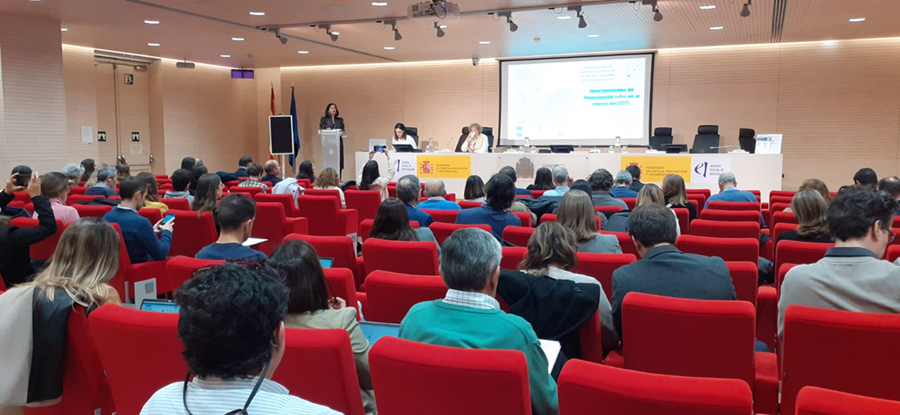
- The Interplatform Group GIEC held the event ‘Challenges and Opportunities for Public-Private Collaboration’ in the circular economy to present the main lines of support in R&D&I and share success stories and proposals for innovative projects.
- The event featured representatives from the State Agency for Research (AEI), the Center for Technological Development and Innovation (CDTI), and the Ministry for Ecological Transition and the Demographic Challenge.
Madrid, November 14, 2024. Yesterday, the annual meeting of the Interplatform Group for Circular Economy (GIEC) took place at the State Agency for Research, under the slogan ‘Challenges and Opportunities for Public-Private Collaboration’ in the realm of the circular economy. Key information was provided about public-private funding calls within the framework of the State Agency for Research (AEI), the Center for Technological Development and Innovation (CDTI), and the Ministry for Ecological Transition and the Demographic Challenge, in addition to presenting proposals and success stories with the aim of inspiring new initiatives.
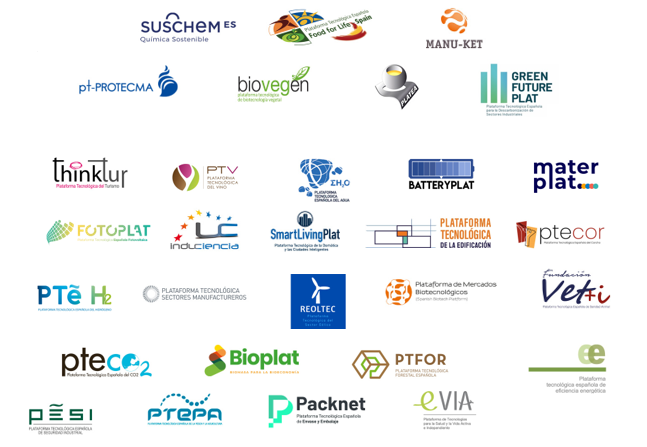
Paloma Pérez, coordinator of the Spanish Technological and Innovation Platform in Biocircularity (BIOPLAT), presented the 30 Platforms that are part of the GIEC Group, which represent strategic sectors in Spain for the transition to a circular economy and contribute to solving social challenges and the Sustainable Development Goals. She explained that the Interplatform Group GIEC promotes the circular economy through public-private collaboration and R&D&I, contributes to the implementation of national and European strategies in this area, encourages the launch of collaborative R&D&I projects, and carries out various activities such as position papers, workshops, and outreach initiatives.
María Ángeles Ferre, head of the Scientific-Technological Thematic Programs Subdivision of the State Research Agency, addressed the current public-private collaboration aid aimed at financing experimental development projects in collaboration between companies and research organizations. This call, with a total budget of 320 million euros, seeks to advance the incorporation of scientific and technological knowledge and results that allow for the validation and pre-competitive development of new technologies, products, and services that stimulate the generation of a critical mass in R&D&I for their application, transfer, search for solutions, and generation of results in technological trajectories and innovation in companies and the market. Ferre emphasized that these projects aim to mobilize private investment, generate employment, improve Spain’s technological balance, and enhance the competitiveness of the business fabric.


In representation of the Center for Technological Development and Innovation (CDTI), Lydia González, from the Climate area (Cluster 5) and PNC from the Environment area (Cluster 6) of Horizon Europe, and María José Tomás, from the Institutional Promotion and Territorial Cooperation department, delved into the different funding opportunities for R&D&I from the entity, focusing on “helping to grow and create a future.” They also detailed the possibilities that Horizon Europe offers for R&D&I projects in circular economy, a cross-cutting area in the Strategic Plan 2025-2027 of this program, which has also gained importance in the new political period and in the priorities of the European Commission for the coming years. Alejandro Dorado, commissioner for the Circular Economy, was responsible for providing the keys to the Circular Economy PERTE of the Ministry for Ecological Transition and the Demographic Challenge. Dorado emphasized that the aim of this funding is to “promote the sustainability and circularity of industrial and business processes to improve the competitiveness and innovation of the industrial fabric within a circular economy.” The commissioner stated that it is essential to promote the circular economy due to the current environmental necessity, the economic opportunity it presents, the job creation it generates, and the strategic autonomy it entails for the country.
After each institutional presentation, a space was opened for sharing successful cases and proposals presented in each of the calls from these organizations, with the intervention of a total of ten entities to present the following projects:
- FUTURECORK: a transformative project for the promotion of bioeconomy in the cork sector. Mariola Sánchez. CIFOR-INIA-CSIC
- WILDBIOPHAGE: new probiotics and phages to combat the incidence of Enterococcus in poultry farming. Sandra Sevilla-Navarro. CECAV
- CHITINMETICS: valorization of chitosan for the production of sustainable plastics for the cosmetics industry and to ecologize the properties of cosmetics. Sofia Garro. Tebrio
- ACICORK (climatically smart cork oaks): tools for forest management and monitoring, cork characterization, and combating the Dryness (P. cinnamomi). Mariola Sánchez. CIFOR-INIA-CSIC
- ECOVir-Mg: Feasibility of a circular process to manufacture profiles and tubes of magnesium alloys from recycled machining chips. Gerardo Garcés. CENIM-CSIC
- REBIOWIND: biological recycling of composite materials for energy and aerospace sectors. Noelia Mendoza. Instituto Tecnológico de Aragón (ITA)
- MEDINSPAIN: innovative methods and national value chain for the circularity of energy storage systems, including classification, reuse, recycling, and automation for the recovery of strategic materials. Oscar Miguel. CIDETEC
- RENEMAG: Recycling and New Circular Economy of magnetic materials from the wind sector. Ibon Ocaña. CEIT-BRTA
- ECOPIGMENT: Manufacturing of Fe-based pigments from metallurgical waste for use in microcements. Vicente Sales. AIDIMME
- REGATEX – Pilot plant for the recovery of textile fibers and INNCENSAS – Project for the recovery of ashes from the boiler of the biomanufacturing plant in Pontevedra. Antonio Casal. ENCE Energy and Cellulose


