


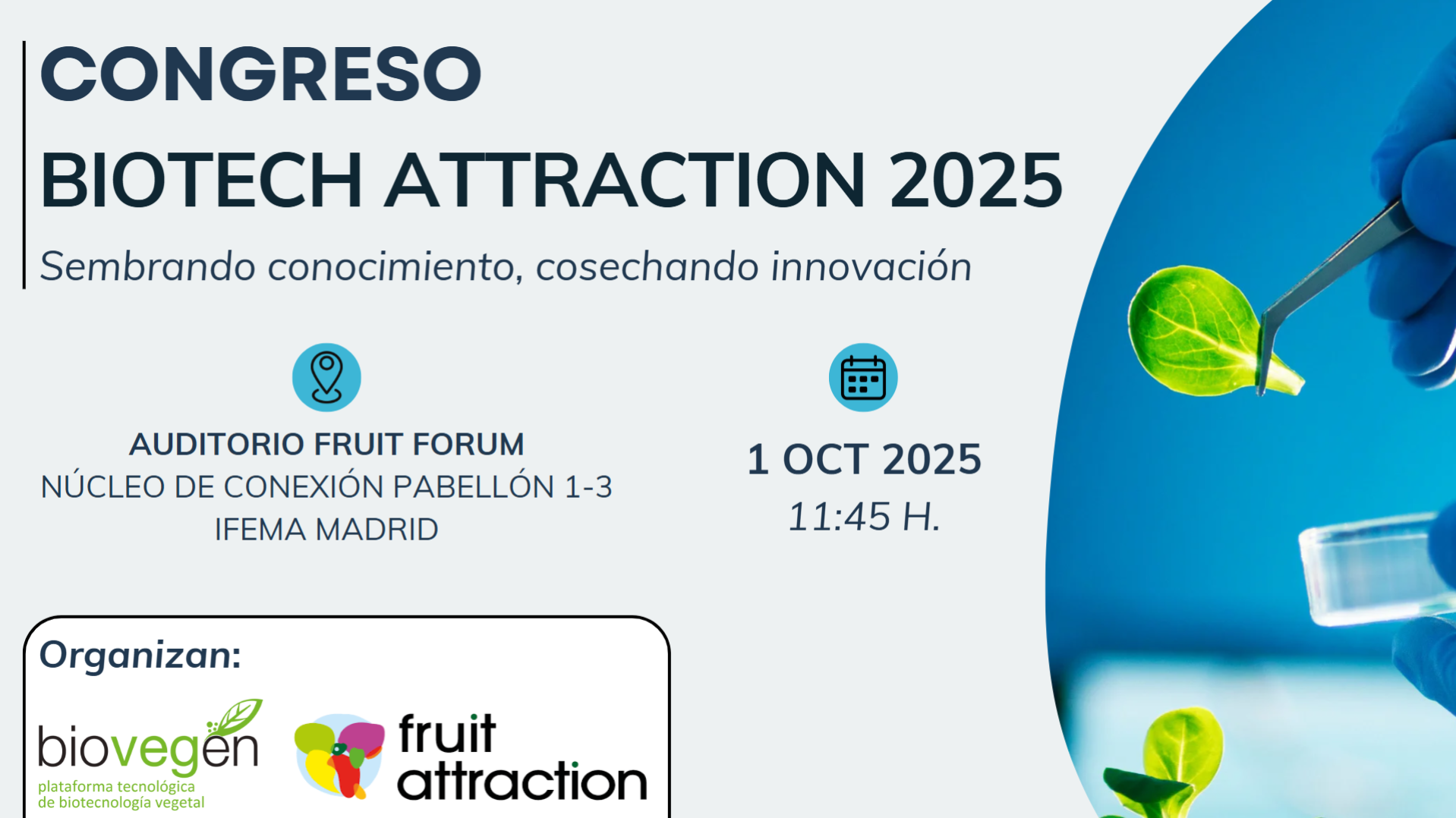
- The Congress BIOTECH ATTRACTION debate on the document ‘Mapping the Agrotech Ecosystem’ sheds light on the existence of an important network of 850 startups focused in Andalucía, Catalonia, Valencia, and Madrid, leading driver industries, and a vast network of universities, technological parks, incubators, and hubs but also highlights shadows: ‘there is a lack of connection, size, and incentives, along with an excess of bureaucracy’
- ICEX, Cajamar, and BIOVEGEN agree that Spanish agro technology is promising, attracting venture capital and multinational headquarters, and is awaiting the regulation of genetic editing (NGT’s), but they warn that one cannot ‘continue living off the lower labor costs – 19% lower than in the EU – because our non-European competitors are cheaper’
Madrid, 7-10-2025.- The debate among the authors of the document ‘Mapping the Agrotech Ecosystem in Spain’ was the center of attention at the BIOTECH ATTRACTION Congress promoted by BIOVEGEN during the latest edition of Fruit Attraction. About 300 researchers and entrepreneurs filled the Fruit Forum, where some of the conclusions of this document promoted by ICEX and Cajamar were presented, a genuine audit of the Spanish technological industry dedicated to agriculture. Its significant potential was showcased: the aforementioned work has identified a dense network composed of 850 startups – focused in Andalucía (181), Catalonia (126), Comunidad Valenciana (110), and Madrid (109); a strong research platform with 50 specialized universities, 20 mixed or private technological centers and parks, at least 24 sectoral and/or autonomous clusters, 7 technological platforms – such as BIOVEGEN itself, dedicated to biotechnology – regional innovation hubs, and incubators that help companies emerge and grow from their first patents or plant acquisitions.

But Spain also boasts leading industries – such as olive oil, citrus fruits, and pork – that act as “engines” of a powerful agri-food sector that exports almost 20% of our country’s goods and has been growing in productivity (by 0.9% annually) above the rates of our surroundings. Additionally, as highlighted in the report and discussed during the debate, there is great interest from seed giants like Bayer, Syngenta, RijK Zwaan, or Sakata, who already have offices in our country and are recently collaborating with Spanish firms. Not to mention venture capital, which in the last two years (2024 and 2025) has been behind numerous consolidation operations, including in R&D, through funds and SCRs. This situation, according to the director of BIOVEGEN, Gonzaga Ruiz de Gauna, allows us to describe the state of Spanish agrotech as “boiling. Today we have talent and knowledge, we attract multinationals and foreign capital, but tomorrow, when we consolidate this sector, we can become a powerhouse exporting our agri-technology.”
These were some of the reflections and data that arose during the debate led by Inés Lucía, investment manager at ICEX, which also included Juan C. Gázquez, deputy director of Cajamar Innova – representatives of the entities promoting the report – as well as Gabino Sánchez, business director of Hudson River Biotechnology (HRB, from the Netherlands), one of those specialized companies in CRISPR that have committed to working in Spain, and Ruiz de Gauna himself (BIOVEGEN). Gázquez detailed the areas of specialization of over 850 Spanish startups: almost 30% are in precision agriculture and livestock, another 17% work on integrating the management of these productions; 15% in robotics and mechanization, and nearly 12% in biotechnology.
In this latter sector, there is anticipation -not without some anxiety- regarding the regulatory proposal that the EU began debating in 2023, which still seems to be stalled and is ongoing in the trilogues (Parliament, Council, and European Commission) and that must replace the restrictive one on Genetically Modified Organisms (GMOs) to regulate more flexibly the so-called New Genetic Editing Techniques (NGTs). To prepare for the launch of this sector -focused on techniques for plant improvement such as CRISPR- the progress of the nGENIA project was subsequently presented, led by Amparo Monfort, researcher at the Centre de Recerca en Agrigenòmica (CRAG) – one of the main Spanish consortia in this field – a group of experts who are already advising the Ministry of Agriculture on the development of NGTs and organizing meetings with groups of investors.

The shadows: lack of incentives, disconnection, atomization, and bureaucracy
However, the agrotech sector also faces significant uncertainties. Sánchez, an executive from the Dutch biotech company HRB, acknowledged that one of Spain’s attractions remains its labor costs—which are 19% lower than the EU average—but also warned about the absence of measures to ‘retain or attract talent (in the Netherlands, there are considerable exemptions for these profiles for 5 years) and generally to reduce the tax burden on R&D investments (which in that country are also heavily subsidized). Gázquez (Cajamar), for his part, pointed out that despite the progress, ‘we still have a research system that is under-structured, not sufficiently interconnected, and a business fabric of small size, atomized,’ therefore he called for measures on both fronts.
The director of BIOVEGEN -in line with the other participants at the table- concluded that, beyond the privileged natural conditions for the Spanish industry, geographical and climatic factors, “agritech cannot continue to survive on salaries lower than in the EU because in this same market we are already competing with other agricultures, south of the Mediterranean or from Latin America, with much cheaper productions. R&D is our path to generate value.” He also referred to the Spanish regulatory framework to fiscally incentivize these investments: “Either it is not known or it involves too much bureaucracy or probably both things.”
AI, digitalization, and edited Spanish crops
Before all this, the inauguration of the congress was led by the Vice President of Innovation and Transfer of CSIC, Ana Castro, and the host and president of BIOVEGEN, José Pellicer. The latter already advanced many of the contributions that would later be highlighted in subsequent presentations: “We have three disruptive technologies that are accelerating everything and are mutually reinforcing: the boost of Artificial Intelligence, the digitalization of processes, and the precision of new genomic techniques. Agriculture and food cannot, nor do I believe they will, turn their back on this revolution that we have already started.”
Additionally, before the closing remarks by the director of Technology at CDTI Innovación, Carlos de la Cruz, three successful cases of technology transfer in public-private consortia, in which these three technologies are present in some way, were discussed: Jorge Lozano from IBMCP (UPV-CSIC) presented the resource of drugs to increase drought tolerance; Francisco Bermúdez, CEO of Beyond Seeds, presented the results of an operational group, GO Biodif, on nano-fertilizers (nutrients and bioactive compounds) for table olives and olive oil; and finally, Pablo Gutiérrez from Viveros Integrales El Ejidillo, discussed the GO Simbioliva project for the revaluation of pomace. The researcher from IBMCP (UPV-CSIC, Valencia), José M. Mulet, presented one of the most advanced Spanish projects for improvement through CRISPR: broccoli varieties resistant/tolerant to water scarcity and therefore more flavorful and enriched with amino acids. Despite the absence of the announced legislation, this research is already in the field trial phase (and there are three other genetic editing projects also in that situation: two on corn, in Aragón and Andalucía, and another in Valencia on a tobacco plant that does not produce nicotine but anatabine, which has anti-inflammatory and neuroprotective properties).
Summary video
Gallery


Program and presentations
11:45 a.m. Registration and collection of accreditations
12:00 p.m. Welcome and introduction
- María José Sánchez. Director FRUIT ATTRACTION
- Ana Castro. Vice President Innovation and Transfer CSIC
- José Pellicer. President BIOVEGEN
12:15 p.m. Round table: Potential and perspectives of the Spanish agrotech sector
- ICEX. Inés Lucía Orea. Investor services manager
- CAJAMAR INNOVA. Juan Carlos Gázquez. Deputy Director
- BIOVEGEN. Gonzaga Ruiz de Gauna. Manager
- HUDSON RIVER BIOTECHNOLOGY. Gabino Sánchez. Business Director
13:00 h. Advances in precision plant improvement
- NGenia: consulting on new genomic techniques for innovation in agriculture. Amparo Monfort. CRAG
- Making the broccoli of the future now. José Miguel Mulet. IBMCP (UPV-CSIC)
13:30 h. Public-private partnerships in agri-food innovation
- Discovery of drought-resistant drugs. Jorge Lozano. IBMCP (UPV-CSIC)
- BEYOND SEEDS BIOTECH: beyond the seed. Francisco Bermúdez. CEO BEYOND SEEDS
- SIMBIOLIVA: biotechnological revaluation of the pomace. Pablo Gutiérrez. Integrated nurseries El Ejidillo
14:15 h. Conclusions and closing
- Carlos de la Cruz. Director of Technology and Internationalization CDTI INNOVATION
14:30 h. Cocktail and networking