


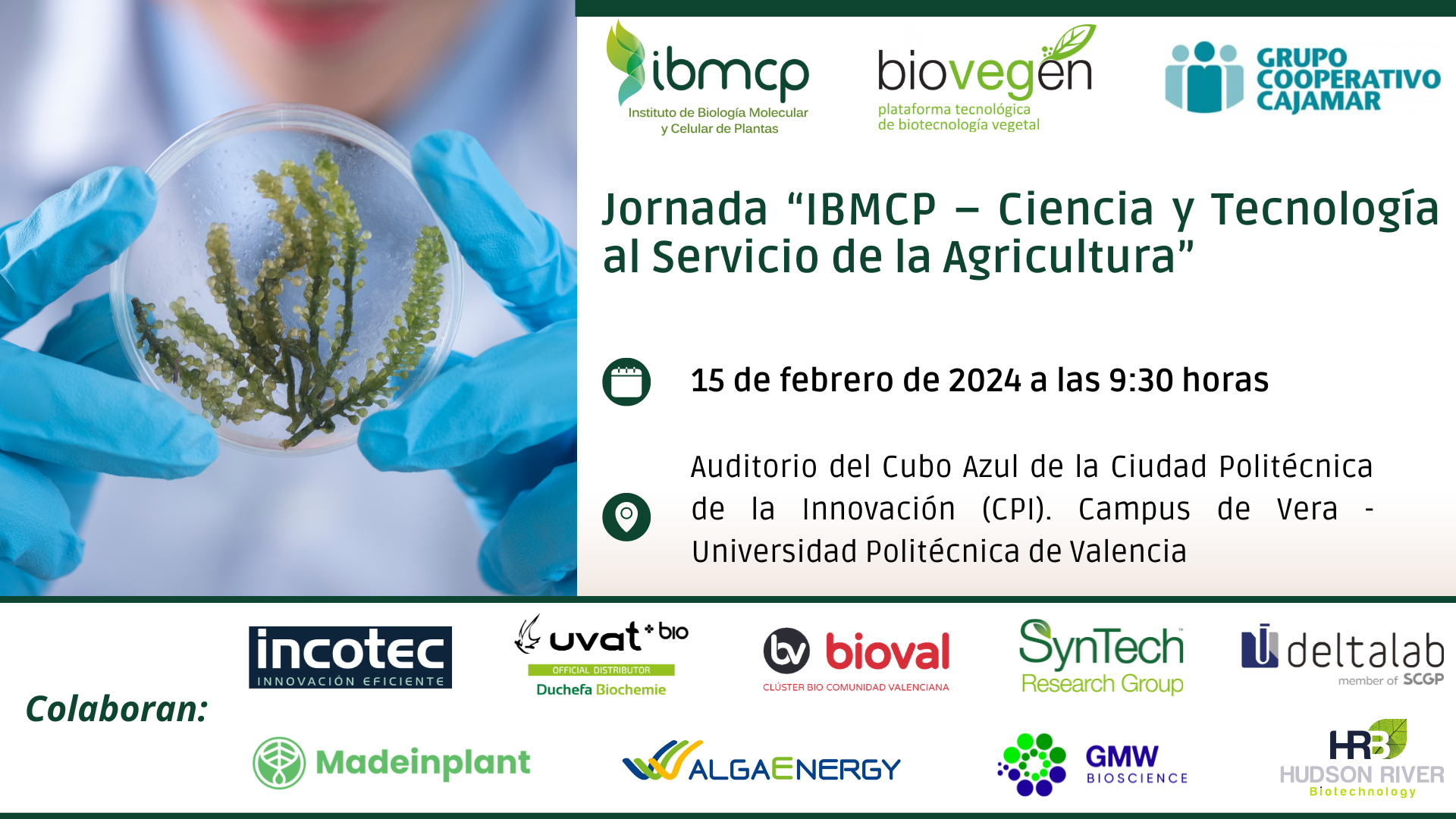
- BIOVEGEN, the Institute of Molecular and Cellular Biology of Plants (IBMCP-CSIC) and Cajamar, managed to schedule more than 400 bilateral contacts between entrepreneurs and scientists during the event held yesterday in Valencia to develop biotechnology projects
- The Ministry of Agriculture expressed its satisfaction during the meeting with the recent approval by the European Parliament of the Brussels proposal on New Genomic Techniques (NGT’s) and informs of “advances” in negotiations with the Council
- The IBMCP showcases the potential of its facilities, the progress of the projects it is already developing with CRISPR, and its great short-term perspectives in synthetic biology, computational biology, or molecular sensing to impact the agri-food sector
Improved crops, more productive and nutritious, with other organoleptic properties and adapted to drought; new opportunities for the industry and distribution to reduce food waste; varieties with genes that incorporate resistance to pests or diseases to facilitate the transition from chemical to more biological agriculture… The future is already present, it’s here and it comes hand in hand with the possibilities offered, especially by New Genomic Techniques (NGTs) and advancements in biotechnology in general. This was highlighted yesterday during an event that brought together more than 300 researchers, entrepreneurs, and professionals from the agri-food sector at the Polytechnic City of Innovation in Valencia (UPV). The meeting, organized by the platform dedicated to promoting these technologies in agriculture, BIOVEGEN, by the Institute of Molecular and Cellular Biology of Plants (IBMCP-CSIC) – one of the reference centers in their development – and CAJAMAR – significant for its support for agricultural innovation – facilitated over 400 bilateral contacts between providers and demanders of biotechnologies for the development of such projects. Moreover, it served to confirm the high expectations raised following the approval on February 7 by the European Parliament of the European Commission (EC) proposal to regulate the aforementioned NGTs “after more than 20 years under the same restrictive regulatory framework.”

Ana Judith Martín de la Fuente. Secretary of the Interministerial Council of GMOs of MAPA. General Subdirection of Agricultural Production Means and OEVV.
This is how Ana Judith Martín introduced the issue, the head of the Ministry of Agriculture who during the Spanish presidency of the EU in the second half of 2023 was responsible for leading the technical file to promote this decisive future European regulation. As she clarified at the beginning of the day, today all plants obtained through NGTs (among which CRISPR or genetic editing stands out) are subject to the same regulation as any Genetically Modified Organism (GMO), that is, to a directive from 2001. However, as was also emphasized in the successive presentations made afterwards, there are significant differences between edited plants and GMOs. In comparison to an original, unmodified organism, those produced by NGTs may have small changes in their genetic code that could also occur in nature or through conventional breeding. The difference is that these techniques for ‘editing’ genes and inducing those changes are now more precise, powerful, better targeted and allow for the shortening and reduction of breeding processes, from decades to years. “We are leaving no stone unturned to promote this regulation, and beyond the pronouncement of Parliament, I believe we have also made progress in negotiations with the European Council,” Martín pointed out.
Laura Zacarés, head of Technology Transfer at IBMCP-CSIC, had previously outlined the capabilities of this center to focus on the development of these NGTs but also of other emerging fields such as synthetic biology, computational biology, biological chemistry, or areas like molecular sensing for the benefit of the agricultural sector, the food industry, and health (animal, plant, and human). With a background of 35 years, 220 employees, 7,000 square meters of its own laboratories, and another 4,200 of greenhouses and growth chambers, the “IBMCP wants to be one of the driving forces for innovation that the European Green Deal – now under review – the climate emergency, legislative pressure, and the demands of consumers themselves push us towards,” Zacarés stated.

Laura Zacarés. Head of Technology Transfer at IBMCP and Innovation Agent of AVI.
And from words, it moved immediately to actions. Successive researchers from IBMCP reported to the entrepreneurs present there on the advances already made thanks to CRISPR and which could soon crystallize into new initiatives and projects for the production of high-value molecules for the renewable energy sector (biofuels); the obtaining of phytonutrients and biostimulants with antioxidant properties; the control of flowering in crops to adapt to climatic or productive demands, or the generation of androsterile parents (without pollen) to facilitate the plant hybridization process, reducing costs and time; the development of highly specific RNA-based vaccines that can be applied to plants without resorting to transgenesis for the control of viral diseases instead of phytosanitary products…
There was also time to confirm and testify how biotechnology is being applied in the world of agri-food companies through successive success cases: at Anecoop – the largest fruit and vegetable cooperative in the country, with a turnover of 998 million euros and more than 22,000 associated farmers – for the selection of the most suitable varieties of late mandarins, kiwis, or persimmons; at Importaco – the Spanish giant of nuts, with 2,300 employees, 17 factories, and 815 million in business volume – which has achieved results that improve the micronutrients present in its pistachios, cashews, or macadamia nuts, to prevent allergic reactions or enhance their properties as probiotics; at RIJK ZWAAN – one of the largest developers of vegetable varieties in the world – which, among many other improved varieties, has obtained and markets cucumbers with higher content of potassium, magnesium, sugar, vitamin K, or water than isotonic drinks, or beans with more vitamin A and carotenoids than other varieties of this crop.
Gallery


Program
- 9:30 h. Reception of attendees and welcome coffee.
- 10:00 h. Opening of the Day.
- Pablo Vera. Director, IBMCP.
- José Manuel Enriquez. Manager of Agri-food and Cooperative Business DT Valencia.
- José Pellicer. President, BIOVEGEN.
- 10:20 h. IBMCP: Creating the future of agriculture together.
- Laura Zacarés. Head of Technology Transfer, IBMCP and Innovation Agent, AVI.
- 10:40 h. Situation in legislation and regulations for NGTs.
- Ana Judith Martín de la Fuente. Secretary of the Interministerial Council of OMG. Ministry of Agriculture, Fisheries and Food. General Subdirectorate of Agricultural Production Means and OEVV.
- 11:00 h. Towards a new generation of treatments.Moderator: Carlos Baixauli, CAJAMAR.
- Natural compounds as an alternative to synthetic compounds to increase efficiency in crops. Purificación Lisón, IBMCP.
- Discovery of drugs to improve crop drought tolerance. Jorge Lozano – Juste, IBMCP.
- RNA-based vaccines against viruses. Alberto Carbonell, IBMCP
- Bio-stimulants based on natural compounds. Ángela Borrás, PLYMAG.
- 12:00 h. New, more efficient and nutritious varieties.Moderator: David Lapuente, BIOVEGEN.
- Applications of Plant Synthetic Biology. Diego Orzáez, IBMCP.
- Improvement of the nutritional quality of plant products. Manuel Rodríguez Concepción, IBMCP.
- Importaco: bioavailability of nutrients in dried fruits. Amparo Devesa, IMPORTACO.
- New, more nutritious crop varieties. Bernardo Cuenca, RIJK ZWAAN.
- 13:00 h. Cocktail and networking
- 15:00 h. Sustainability in the production chain.Moderator: Jaume Martínez, IBMCP.
- Zero-residue crops. Francisco José Escaray, IBMCP.
- Valorization of by-products for their use as bio-stimulants. José Miguel Mulet, IBMCP.
- Disease-resistant plants for reducing pesticide use. José Antonio Darós, IBMCP.
- How biotechnology can help increase sustainability in the field. Victoria Ibáñez and Nicolás Juste, ANECOOP.
- Agroparc: Sustainable production chain “from field to table”. Joan Simó, Ametller.
- 16:00 h. Open innovation and technological transfer. Moderated by: Laura Zacarés, IBMCP.
- BIOVEGEN as an example of an open innovation ecosystem. Gonzaga Ruiz de Gauna, Manager at BIOVEGEN.
- Cajamar Innova. Juan Carlos Gázquez Garrido, Deputy Director of the High Technology Business Incubator in Water, Cajamar Foundation.
- Round table: Accelerating and creating the future of the sector through open innovation and technological transfer.
- AVI-Valencian Agency for Innovation. Victoria Gómez Galdón, Head of the innovation unit of IVACE + i.
- AVA ASAJA. Carlos Montesinos, Innovation Agent and Project Manager.
- MADEINPLANT. Federico Grau, CEO.
- SWANLAAB. Nora Alonso, partner and investment director of the Agri-Food Tech Fund.
- BIOVAL. Jesús Agüero, Director of BIOVAL and Innovation Agent.
- 17:15 h. Closing
- Laura Martí Barranco, Deputy Director General of Innovation Programs at IVACE+i.
- Javier Bartolomé, Autonomous Secretary of Agriculture, Livestock, and Fisheries.